
April 2026
THE CIO’S PERSPECTIVE
The military escalation involving the United States, Israel and Iran at the start of the month sent an immediate shock through Asian markets. Because crude flows through the Strait of Hormuz serve Asian demand disproportionately, the economic repercussions were felt first — and most acutely — across the region. Countries heavily reliant on Gulf oil, including the Philippines, Myanmar, Cambodia, Bangladesh and Pakistan, have already introduced severe rationing measures, while others have cut fuel taxes or expanded subsidies in an effort to contain the pass-through to domestic consumers.
Our central scenario remains that of a prolonged oil shock, one that is likely to drive Brent and WTI meaningfully higher from here. Yet, in our view, the market’s focus on oil alone is too narrow. The more enduring disruption may emerge in liquefied natural gas and associated industrial gases, where supply chains are more specialised, substitution is limited, and the downstream implications for global industry could prove both broader and deeper.
That broader risk is now visible in Qatar. As of the time of writing, two of the fourteen production trains and associated downstream chemical units at the QatarEnergy Ras Laffan LNG complex have been seriously damaged, removing 17% of Qatar’s LNG production capacity and 14% of its helium production capacity. Management has indicated that repairs may take between three and five years. This matters not only because Ras Laffan is the largest LNG complex in the world, but because it also represents a critical node in the supply of high-purity helium, reportedly accounting for 65% of South Korean chipmakers’ N6 helium requirements and 69% of Taiwan’s, according to Barclays Bank. Even if hostilities were to cease immediately, restoration would likely be measured in months rather than weeks, with downstream gases such as helium taking longer still to return, given the need for each stage of the process to be tested, certified and sequenced before full operations can resume. For now, the complex remains shut and personnel have been sent home.
The implications for semiconductors — and, by extension, the global rollout of AI infrastructure — could be substantial. Helium may represent less than 0.1% of the manufacturing cost of a chip, but its functional importance is far greater than its economic weight. It is essential to wafer cooling, photolithography, plasma etching, deposition, contamination control and micro-leak detection across fabrication equipment. At present, there is no practical substitute. TSMC, SK Hynix and Samsung Electronics have all indicated that inventories are sufficient for “a few months”, which analysts broadly interpret as two to six months of supply.
The ramifications extend beyond memory. Micron Technology should be less exposed, given its access to a dedicated Air Liquide facility adjacent to its fab in Boise, Idaho. However, memory alone does not define the AI buildout. Advanced memory must be paired with Nvidia or AMD GPUs, and the most advanced of those chips continue to be manufactured in Taiwan by TSMC. TSMC’s Arizona facility currently produces Nvidia’s Blackwell GPU, which remains well behind the leading edge. As a result, the roughly USD 700 billion of capex planned by hyperscalers in 2026 may yet collide with physical bottlenecks in GPUs and memory, introducing meaningful execution risk into the broader data-centre supply chain. This is particularly relevant given that Nvidia’s Hopper 200 GPU typically requires eight HBM3e chips, while Rubin, the next-generation architecture expected later this year, will require twelve chips based on the HBM4 standard.
Against this backdrop, Korean and Taiwanese chipmakers face a particularly difficult operating environment because of their dependence on specialty gases sourced from Qatar. Chinese semiconductor manufacturers, by contrast, may be somewhat more insulated in their legacy-node businesses, as China sources 54% of its high-grade helium imports from Russia. That share could rise further as the conflict reinforces geopolitical alignment between the two countries. Even so, China remains materially behind the technology frontier. SMIC has only recently begun producing 7nm chips, whereas TSMC is already at 2nm. ChangXin Memory Technologies, China’s most advanced memory producer, is not expected to manufacture HBM3 chips before year-end and remains roughly three years behind SK Hynix.
Helium is not the only concern. We also expect disruption to the global supply of sulphuric acid, used as a leaching reagent in metals processing, and urea, a vital feedstock in fertiliser production. Ras Laffan is the world’s second-largest exporter of both, with an estimated global market share of around 15% in each category, and the site is effectively offline. In that context, India appears particularly vulnerable, given the central importance of fertiliser availability to agricultural output and food security.
Not all consequences are negative. The current shock is likely to strengthen the medium-term case for renewable-energy platforms and for battery manufacturers in particular, whether in electric vehicles or in energy storage systems for data centres. Solar power is now cheaper than coal-fired power in China, creating a clear economic incentive for industrial groups and hyperscale operators to accelerate investment in renewables and storage. That relative attractiveness becomes even stronger as higher oil and coal prices feed through the system. In that respect, it is notable that CATL, the world’s largest battery producer, and Sungrow Power Supply, a leading manufacturer of inverters and energy storage systems, have shown an increasingly positive correlation with the oil price.
At the macroeconomic level, China has again surprised positively. The trade surplus for the first two months of the year rose 21.8% year on year, while profits among industrial companies increased 15.2% over the same period, marking the strongest start to a year since 2018. Electronic manufacturers saw profits rise by more than 200% year on year. That said, the durability of this momentum is now in question. A 50% rise in oil prices during March is likely to compress margins meaningfully across large parts of the industrial economy.
Beijing, for its part, has so far responded with restraint. Petrol prices in China have risen by only 10% to 13%, compared with 68% in Cambodia, 33% in Laos and Vietnam, and 25% in Pakistan. China also enjoys several buffers: strategic reserves of 1.4 billion barrels, equivalent to around four months of consumption; continued access to a large share of Iranian exports; and the ability to bring coal-fired power generation back online if required. According to the Energy Institute’s Statistical Review of World Energy, oil and gas represented 27.2% of China’s primary energy consumption in 2024, against a global average of 54.6%. Given the continued expansion of renewables, that share is likely lower today.
Elsewhere in Asia, the consequences are likely to be more inflationary. Higher oil prices should place renewed pressure on regional currencies and may accelerate the timetable for monetary tightening. Australia has already moved. China remains the exception, with inflation still below the PBoC’s 2% target, at 1.3% in February versus 0.2% in January.
One of the more striking market developments during the month was the behaviour of gold. Rather than serving as a defensive hedge, gold fell 14% from the start of hostilities, with silver down 22%. In our view, this reflects an important change in market structure. Gold has increasingly traded less as a store of value and more as a speculative instrument, particularly since mid-2025, as retail investors using margin financing have become more active alongside central banks. As risk assets sold off in March, leveraged positions in precious metals were also unwound, accelerating the correction. Rumours that certain central banks may need to sell gold reserves to offset higher energy-related fiscal deficits only added to the pressure.
WORDS FROM THE MANAGER
Monthly Performance
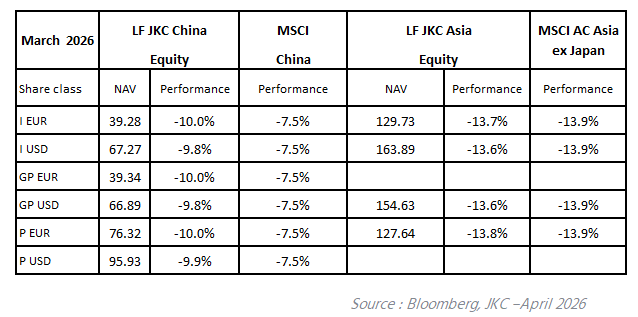
The conflict with Iran prompted a meaningful repositioning of the portfolios. Our first decision was to raise cash materially, reflecting our assessment that the conflict may prove both longer and more economically disruptive than initially expected. In periods where the macro regime is shifting abruptly, preserving flexibility is itself a form of risk management.
We exited our gold-related positions, with the exception of Zijin Mining, China’s largest copper producer and the world’s fourth largest, which also has meaningful gold-mining operations. We retained a reduced holding in recognition of the company’s operational quality and management strength.
Within financials, we moved decisively away from the Chinese life insurance sector, which materially underperformed in March because of its sensitivity to equity-market declines. In some cases, equity exposure accounts for as much as 20% of portfolio assets. By contrast, we increased exposure to Chinese banks, whose earnings profiles and balance sheets proved more resilient in the face of market volatility.
In technology, we cut our previously large overweight positions in SK Hynix and Samsung Electronics to underweight positions. At the same time, we increased exposure to areas we see as more directly aligned with the next phase of infrastructure investment, notably thermal management and data-centre energy storage, through larger positions in Kaori Heat Treatment in Taiwan and Sungrow Power Supply in China.
March was also an important reporting month, with most portfolio companies publishing their 2025 annual results. Broadly speaking, earnings came in ahead of expectations. The main disappointments were Alibaba, Trip.com, Kuaishou and Tencent Music. On the other hand, Tencent, CATL and WuXi AppTec delivered the most positively surprising results within the portfolio.
CHINA PORTFOLIO
La Francaise JKC China Equity saw its NAV per share decline by 9.8% in March, while the MSCI China Index dropped 7.5% over the same period.
The fund’s cash position, including its holding in a monetary fund, stood at 22% at month-end.
The best performers were Akeso, up 21.8%, CATL, up 17.5%, Bank of China, up 7.1%, ICBC, up 6.4% and China Construction Bank, up 5.0%. The weakest performers were SMIC, down 25.4%, Zijin Mining, down 23.6%, China Life, down 22.1%, Suzhou TFC, down 18.2% and JD Health, down 17.1%.
During March, we increased exposure to JD Health, Sungrow Power Supply, ICBC, China Construction Bank and Bank of China. We reduced exposure to China Life Insurance, Ping An Insurance, Trip.com and Suzhou TFC, and exited Zijin Gold International, Zhaojin Mining, Kuaishou, Tencent Music and Sanhua Intelligent Controls.
ASIA PORTFOLIO
La Francaise JKC Asia Equity saw its NAV per share decline by 13.6% in March, while the MSCI Asia ex-Japan Index dropped 13.9%.
The fund’s cash position, including its holding in a monetary fund, stood at 21.1% at month-end.
The best performers were CATL, up 17.4%, Sheng Siong, up 7.2%, Bank of China, up 7.1%, ICBC, up 6.4% and Chroma ATE, up 6.2%. The weakest performers were SMIC, down 25.4%, Zijin Mining, down 23.6%, SK Hynix, down 23.4%, Samsung Electronics, down 22.4% and Polycab, down 20.5%.
During March, we materially reduced exposure to SK Hynix and Samsung Electronics, while exiting Ping An Insurance, Zijin Mining, Zhaojin Mining, Tencent Music and Kuaishou. We increased exposure to JD Health, Sungrow Power Supply, Kaori Heat Treatment, WuXi AppTec, ICBC, China Construction Bank and Bank of China.
ESG HIGHLIGHTS IN 2025
Against a global backdrop dominated by renewed energy insecurity, China announced a fresh set of climate and transition targets this month as part of its 15th Five-Year Plan. The headline objectives include a 3.8% reduction in CO₂ emissions intensity in 2026 and a 17% reduction over the full 2026–2030 planning period. China also reiterated its intention to raise the share of non-fossil energy in total consumption to around 25% by 2030, from roughly 15% today, alongside an existing ambition to exceed 30% by 2035. These targets reinforce the direction of travel even as near-term geopolitical events complicate the energy mix.
In South Korea, the Financial Services Commission published a draft roadmap for the phased introduction of mandatory sustainability disclosures. Under the proposal, climate-related reporting could begin as early as 2028 for KOSPI-listed companies with consolidated assets above KRW 30 trillion, before expanding in 2029 to companies with assets above KRW 10 trillion. A further widening of the regime remains possible, subject to market readiness and developments in the international reporting framework.
In Europe, the European Commission released its long-awaited Industrial Accelerator Act proposal in March, an important milestone in the EU’s effort to combine industrial policy with decarbonisation objectives. The package introduces “made in EU” and low-carbon requirements across a range of strategic sectors and net-zero technologies, including batteries, solar, wind, heat pumps and nuclear energy. It also proposes new restrictions on foreign direct investment above €100 million in strategic sectors such as EVs, batteries, solar and critical raw materials, particularly where the investor’s home country controls more than 40% of global manufacturing capacity in the relevant segment.
The information and material provided herein do not in any case represent advice, offer, sollicitation or recommendation to invest in specific investments. The information contained herein is issued by JK Capital Management Limited. To the best of its knowledge and belief, JK Capital Management Limited considers the information contained herein is accurate as at the date of publication. However, no warranty is given on the accuracy, adequacy or completeness of the information. Neither JK Capital Management Limited, nor its affiliates, directors and employees assumes any liabilities (including any third party liability) in respect of any errors or omissions on this report. Under no circumstances should this information or any part of it be copied, reproduced or redistributed.