

March 2026
THE CIO’S PERSPECTIVE
The surge in demand for AI chips impacted greatly the Taiwanese and the Korean economies lately. The appetite for Nvidia and AMD (Advanced Micro Devices) logic chips manufactured by TSMC has pushed the Taiwanese GDP growth to a staggering +12.65% YoY in Q4 2025, up from +8.42% YoY in Q3 2025. The full year growth of the Taiwanese economy in 2025 was 8.63%, the highest print recorded by Taiwan in 15 years.
The momentum is clearly not over: TSMC recorded sales in January up 36.8% YoY, while electronic exports to the US as published by the Taiwanese government and adjusted for the seasonal impact of the Chinese New Year grew by 213% YoY in January, compared to a 216% YoY growth over the fourth quarter of 2025. It is not an understatement to say that the Taiwanese economy is on fire, and the epicentre of that fire is TSMC.
On the memory side, the action is not in Taiwan but in Korea, with SK Hynix being the mirror of TSMC in Taiwan. SK Hynix’s revenues surged by 34% in Q4 2025, and operating profit by 68%. Samsung Electronics and Micron in the US are catching up on SK Hynix, but SK Hynix still enjoys the lion’s share. The global market shares in High Bandwidth Memory (HBM, the memory chips needed to pair with Nvidia and AMD Graphic Processing Units) of SK Hynix, Micron and Samsung currently stand at 61%, 20% and 19% respectively.
All production capacities of the three players are already sold for 2026. It was reported in February that Hynix was now asking its customers to participate in the financing of its new factories in return for guaranteed capacity allocation. In a recent note, Goldman Sachs extended its prediction for the DRAM memory chips upcycle to continue until Q4 2027 (its previous prediction was until Q1 2027). For NAND memory chips, Goldman Sachs extended its upcycle prediction from Q3 2026 to Q1 2027. The demand is so strong that in terms of selling prices, UBS expects DRAM prices to increase by 65% QoQ in Q1 2026, and by another 15% QoQ in Q2, and NAND prices to increase by 40% QoQ in Q1 2026 and 15% in Q2. DRAM prices have already doubled in the past 3 months.
These staggering numbers explain why Korean exports rose by 29% YoY in February, following a growth of 34% YoY in January (the number of working days was cut by three in February due to the Lunar New Year holiday). Semiconductor shipments that account for over a quarter of all exports more than doubled in February this year compared to last year.
No wonder Korea is the best performing market in the world so far this year, the Kospi index being up by a staggering 48.2% since 1st January. The Taiwanese and Korean stock markets are now both larger than the French and German ones.
The dichotomy between the performances of software and hardware companies in February in the US was very interesting. The idea that AI will replace traditional software companies had a drastic impact on that sector which is largely located in the US. The S&P500 Software index is down 21% so far this year when the S&P500 Hardware index is roughly flat. In contrast, in Asia, year-to-date, TSMC is up 29%, SK Hynix is up 63% and Samsung Electronics is up 81%.
The fact that payment solution company Block in the US (formerly known as Square) just announced that it will lay off 40% of its staff, or 4000 people, because AI will do their job is not going to help sentiment towards software companies and all kinds of IT consulting. In Asia, the Indian IT sector that employs 5.8 million is suffering greatly for the same reason: Infosys is down 19% so far this year, and Tata Consulting Services (TCS) is down 17%. In a recent AI summit attended by the CEOs of the main hyperscalers and the largest Large Language Model developers, prime minister Modi showed that the Indian government was trying to reverse the tide by offering a 21-year tax break to any cloud provider and hyperscaler which would build data centres in India. At the same time, Infosys signed a partnership with Anthropic to jointly develop specific AI agents for the exclusive use of Infosys clients.
Our view is that the wave that keeps on pushing higher and higher Asian chip makers that dominate the AI sector is far from over. We certainly do not see any slowdown in hyperscalers’ capital expenditure budgets which stands at present around $700 billion for 2026 for the “Magnificient Seven”. As far as the four largest hyperscalers (Amazon, Alphabet, Meta and Microsoft) are concerned, their capex budget for 2026 stands at $620bn, up from $376bn spent in 2025. A large proportion of that money will end up in the pockets of TSMC, Hynix and Samsung, the picks and shovels of the entire AI sector. Hence our continued bullishness for the sector, despite the tremors seen in the US across the software industry and the lack of performance so far this year of the American AI GPU design houses Nvidia and AMD.
WORDS FROM THE MANAGER
Monthly Performance
Aside the amazing performance of the Korean and Taiwanese markets that we directly benefited from, we saw signs of improvement coming from the Chinese economy. The number of trips made by domestic tourists during the Chinese New Year holiday was 596 million, generating RMB803bn in tourism revenues, both numbers being up by 19% YoY. Admittedly the government extended the statutory holiday this year to nine days to boost consumer spending, up from eight days a year ago and seven days two years ago. The average spending per day based on VAT invoices in consumption-driven industries is still up 13.7% YoY, compared to an increase of 4.5% YoY during the previous holiday, i.e. the National Day Golden Week last October. The main beneficiary should have been Trip.com, the largest online travel agent of China, but the company was unfortunately hit by a government investigation into a possible abuse of monopoly position that penalises hotel operators. Trip.com is down 25% so far this year, and 14.6% in February.
A sector that is expected to face difficulties this year is the Chinese auto sector. The growth in number of new cars sold is dropping fast. Not only did the number of combustion-engine cars sold decrease by 1.7m in 2025, similar to the drop in 2024, but the growth in the sales of EV cars is dropping fast. The number of EVs sold increased by only 1.6m in 2025, down from 3.5m in 2024. The total number of domestic passenger-car registrations was down in 2025 to 23.3m, vs 23.4m in 2024. Exports saved the day for Chinese auto makers. Our funds are no longer exposed to two Chinese car makers they owned, BYD and Xiaomi. The issue for Xiaomi was compounded by the sharp drop we are seeing in smartphone sales, Xiaomi being also a leading smartphone manufacturer. According to IDC, a leading market intelligence data provider, smartphone sales are expected to drop by 12.9% globally in 2026, down from 1.26bn units in 2025 to 1.1bn in 2026. This is partly due to the steep rise in memory chip prices and to a shortage of supply due to memory chip makers switching their production capacity from legacy chips to HBM chips for AI. It is clearly not the right time to be exposed to that sector.
This is in sharp contrast to the situation witnessed in India where the number of passenger cars sales went up by 8.5% in 2025. Mahindra and Mahindra, the sole exposure we have to car manufacturing in India, saw its auto sales volumes in February grow by 18% YoY, and its tractor sales grow by 35% YoY. Unfortunately, its share price is down 8% so far this year, reflecting the doldrums in which the entire Indian equity market stands at present.
The best performer in our China fund was by far Suzhou TFC, an optical communication module manufacturer that supplies Nvidia for its GPU server racks. It is a name we have owned since September 2024 and that saw its share price go up by 665% since we first bought it, and by 48% in February alone. It is one of the numerous A-share companies that applied for a listing on the Hong Kong stock exchange.
Our exposure to gold also did well in February as gold price went up another 7.8% during the month. Zijin Mining gained 7.4%, and Zijin Gold International 7%. Unfortunately, the third name we are exposed to, Zhaojin Mining, lost 4.7% because of a fatal accident in one of its gold mines.
The big Chinese internet names did not perform well this month, presumably because of a lack of catalyst but most likely due to a rotation of large institutional funds towards the Korean and Taiwanese AI-related mega caps. Tencent lost 14.5%, Alibaba lost 15.5%, Baidu lost 19% and Netease lost 12.6%.
The impact of the rotation of large funds towards Korea and Taiwan benefited many of our names. Chroma gained 40.8%, Samsung gained 35.3%, SK Hynix gained 17.6%, Kaori, a name we added in January, gained 17.7%, TSMC gained 12.4%. We also saw some of our Indian names perform well, with Polycab up 22.8%, Eicher up 12.5%, Bajaj Finance up 7.1% and Shriram Finance up 5.8%. The worst performers in our Asia fund were the Chinese large caps mentioned above.
CHINA PORTFOLIO
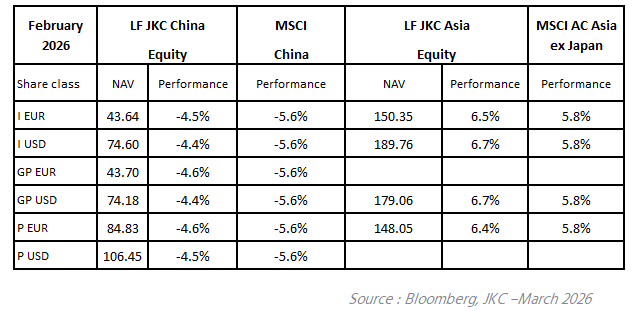
La Francaise JKC China Equity saw its NAV per share drop by 4.6% in February when the MSCI China index dropped by 5.6%.
The cash position of the fund stood at 5.4% at the end of the month.
The best performers in the fund this month were Suzhou TFC Optical Communication (+48.4%), Zijin Mining (+7.4%), Wuxi Apptec (+7.0%), Zijin Gold International (+7.0%) and China Merchant Bank (+2.0%). The worst performers were Kuaishou Technology (-21.6%), Baidu (-19.0%), Alibaba (-15.5%), Trip.com (-14.6%) and Tencent (-14.5%).
Over the month the fund exited BYD and Xiaomi, and increased its position in Wuxi Apptec, Baidu and Zhaojin Mining. No new name was added.
ASIA PORTFOLIO
La Francaise JKC Asia Equity saw its NAV per share increase by 6.7% in February when the MSCI Asia ex-Japan index increased by 5.8%.
The cash position of the fund stood at 3.6% at the end of the month.
The best performers of the fund this month were Suzhou TFC Optical Communication (+48.4%), Chroma ATE (+40.8%), Samsung Electronics (+35.3%), Polycab India (+22.8%) and Kaori Heat Treatment (+17.7%). The worst performers were Kuaishou Technology (-21.6%), Alibaba (-15.5%), Trip.com (-14.6%), Tencent (-14.5%) and Tencent Music Entertainment (-13.2%).
Over the month the fund exited DBS in Singapore, HDFC Bank, Cholamandalam Investment and Finance and Krsnaa Diagnostic in India. It added to the portfolio Delta Electronics in Taiwan, a global leader in switching power supplies and thermal management solutions for numerous industries, with a significant and rising exposure to AI data centres.
ESG HIGHLIGHTS OF THE MONTH
In February, the State Council of China issued guidance to accelerate the buildout of a unified national power market, targeting market-based transactions accounting for 70% of national electricity consumption by 2030, with a fully operational unified market by 2035. By mandating deeper cross-regional integration and the nationwide rollout of spot trading by 2027, the State Council is building the grid infrastructure necessary to absorb large-scale renewable capacity, addressing a long-identified bottleneck in China’s energy transition. It also establishes a green certificate consumption system combining mandatory and voluntary elements, embedding renewable procurement incentives directly into market design—sharpening the investment economics of clean energy and materially shifting the transition risk profile of industrial firms still anchored in regulated coal procurement.
In Europe, the European Parliament passed an amendment to the EU Climate Law by 413 to 226 votes, enshrining a legally binding 90% emissions reduction target by 2040 relative to 1990 levels. The agreement incorporated notable concessions – international carbon credits under Article 6 of the Paris Agreement may contribute up to 5% of required reductions from 2036, and the ETS (Emission Trading Scheme) 2 extension to road transport and heating fuels was delayed one year to 2028 – but the passage of a durable 2040 legislative anchor nonetheless provides a meaningful long-term framework for corporate transition planning and sustainable capital allocation across the bloc.
In the United States, a Texas District Court struck down the state’s “business blacklist law,” Senate Bill 13, ruling it unconstitutional under the Fourteenth Amendment for being impermissibly vague in defining what constitutes a fossil fuel “boycott.” The law had barred state funds from engaging with institutions including HSBC, Schroders, BNP Paribas, Nordea, and UBS, among others. While the ruling removes one of the more aggressive anti-ESG legislative instruments and may deter similarly structured bills in other states, the broader federal anti-ESG posture remains intact. For international asset managers, the US legal landscape remains unsettled and jurisdiction dependent.
The information contained herein is issued by JK Capital Management Limited. To the best of its knowledge and belief, JK Capital Management Limited considers the information contained herein is accurate as at the date of publication. However, no warranty is given on the accuracy, adequacy or completeness of the information. Neither JK Capital Management Limited, nor its affiliates, directors and employees assumes any liabilities (including any third party liability) in respect of any errors or omissions on this report. Under no circumstances should this information or any part of it be copied, reproduced or redistributed.