
February 2026
THE CIO’S PERSPECTIVE
The most important event of the month was without doubt the World Economic Forum held in Davos that saw leaders formally recognise that the world had entered a new era where the United States would no longer be the guide as it has chosen to move towards isolationism. In the days that surrounded the Davos forum and in the midst of the Greenland crisis, we saw back-to-back the Canadian, Finnish and British prime ministers all heading to Beijing to mend their relationships with the Middle Kingdom, while the President of the European Commission headed for New Delhi to sign a new free-trade agreement which she described as “the mother of all deals”. It happened just a few days after the Commission reached another deal, this time with China on the import of Chinese electric vehicles.
The centre piece of all discussions held was the same: How to recreate a new world order, as fast as possible, in which all forms of barriers, including import tariffs, would be cut to make up for the loss of the United States as a free-trade partner. Mark Carney, the Canadian prime minister who delivered the most insightful speech in Davos, stated that his objective was to increase Canadian exports to China by 50% by 2030, oil being on the top of his list. In return he will cancel all import duties on Chinese electric vehicles, up to a certain quota. Maybe this Davos forum will be analysed by historians as having been the starting point of a new globalisation era, this time without the United States. Many commentators pinpointed that the main beneficiary of this Davos forum was China.
One victim of the Davos forum was the US dollar that started correcting as meetings were taking place and speeches delivered. The trigger may have been the Greenland issue, it may have been uncertainties about the future independence of the Fed as its chairman is about to be replaced, or the announcement made by the Dannish pension fund AkadamikerPension on January 20th that it was exiting the US Treasury market. The pace of the US dollar drop accelerated when Donald Trump commented “I think it’s great” when asked about it. The dollar index hit a five-year low on January 27th, before staging a slight rebound. It managed to end the month down only 1.35%, but it dropped from peak to trough within the month by 3.2%.
The Danish pension fund is certainly not the only one cutting its holding of US Treasury bonds: PBoC, the Chinese central bank, cut its holding by 11%, from November 2024 to November 2025 (the latest number disclosed by the US Treasury) down to USD682bn. At its peak in November 2013, it held USD1.32 trillion of US Treasury bonds.
World uncertainties were in full display at the Davos forum. Combined with a sudden steep correction of the dollar, it pushed gold to unprecedented levels at an accelerated pace, only to correct on the last day of the month. At its peak reached on January 28th, gold was up month-to-date by a staggering 25.4%, and silver by 62.8%. Other than pure speculation by some hedge funds and retail investors making leveraged bets, one of the main drivers for the rally has been central banks moving away from US Treasuries and piling on gold reserves. According to latest IMF statistics, gold’s share of central banks total reserves is around 30%, up from 14% two years ago. On the flip side of the coin, their dollar reserves have shrunk from 50% to 40% over the same time frame.
As always, emerging markets benefited from a weak dollar, the MSCI Emerging Market gaining 8.8% in January, its best performance since November 2022. Among emerging markets, Korea was, once again, the clear winner with a Kospi index gaining in January as much as 24%, followed by Taiwan, up 10.7%. These impressive returns were entirely driven by the “picks and shovels” of artificial intelligence, i.e. the chip makers and their supply chains.
We wrote about Indonesia on many occasions over the past year as we are witnessing the country sadly falling into political and economic disarray under the incompetent leadership of Prabowo Subianto, a former general who makes no secret of his admiration for his blood-thirsty father-in-law, the late dictator Suharto. Adding to the pitfalls of a weakening currency and ballooning fiscal deficit driven by populist measures that the country cannot afford, MSCI took the unprecedented action to stop adding Indonesian names to its indices and to threaten the country to downgrade it from “emerging market” to “frontier market” should it fail to raise the minimum free-float condition required for any public company and force listed companies to disclose the identity of their Ultimate Beneficial Owners, or UBOs. As it stands now, Indonesia’s regulations require a 7.5% free float for a company to be listed on the stock exchange. Not only is this 7.5% threshold the lowest in Asia, but it is also a well-known fact that it is not even enforced as related parties and wealthy “friends and family” are typically categorised as third parties minority shareholders. Should the regulator not react, Indonesia is running the risk of seeing most international asset managers, at least those who cannot hold frontier market assets, exit the market. The MSCI announcement saw the main Jakarta Composite Index fall by 10% in two days, the most since 1998. We haven’t had any exposure to Indonesia since February 2025.
The strong performance of North Asian markets over the past twelve months had a real impact on the indices most fund managers and their clients look at: Taiwan now represents 24.0% of the MSCI Asia ex. Japan index, in par with China, and Korea 17.8%. At the end of 2024, Taiwan, China and Korea had respective weightings of 22.1%, 25.8% and 10.1%. In other words, Korea’s weighting in the main emerging market index rose by 76% in one year!
WORDS FROM THE MANAGER
It was an extraordinary month in many respects. Our portfolios benefitted directly from the exposure we have in Chinese gold and copper mining companies (Zijin Mining, Zijin Gold and Zhaojin Mining) as gold and copper rallied by 13.3% and 4.3% respectively. Same as everyone investing in emerging markets, we also benefitted from the recent dollar weakness, and we took advantage of the rising exposure global managers are having on China after JP Morgan upgraded its recommendation towards the country to Overweight. It was not that long ago that the same bank declared China as being “uninvestible”. The geopolitical pivot seen in Davos away from the US and in favour of China certainly contributed to the trend.
Then it was all about our exposure to the “picks and shovels” of the AI industry, namely to TSMC, the largest logic chip maker, to Samsung Electronics, the second largest chip maker that produces both logic chips and memory chips, and to SK Hynix, the largest memory chip maker in the world. It is also through our exposure to their respective supply chains through Suzhou TFC in China that provides communication modules for Nvidia servers, through Chroma in Taiwan that provides chip testing equipment, and through Park Systems in Korea that sells to TSMC and Samsung Electronics atomic force microscopes that are used to do quality control on semiconductors as well as maintenance equipment for their Extreme Ultra Violet (EUV) machines supplied by ASML in Holland.
Recently we started investing in the data centre supply chain, focusing more specifically on the prevailing shortage in energy supply, especially in the United States. We added exposure to Sungrow Power Supply, the largest photovoltaic inverter company in the world and the second largest Energy Storage Systems (ESS) supplier (after Tesla). The angle is the rising need for data centres to regulate their energy supply through large capacity on-site batteries. We also added exposure to Kaori Heat Treatment from Taiwan, a leading provider of liquid cooling devices to data centres, and the sole supplier of heat exchangers (also called “hotboxes”) to Bloom Energy, an American company that supplies hyperscalers with a unique energy supply solution, Solid Oxide Fuel Cells (SOFC) that transform natural gas and hydrogen into electricity without combustion and without water.
Our AI exposure is driven by the ever-rising capex budget of hyperscalers and their growing need for large computing capacity. The four largest hyperscalers (Meta, Alphabet, Amazon and Microsoft) now plan to spend USD480bn of capex in 2026, up from USD360bn in 2025. The latest numbers published by the companies we have exposure to and their respective forecasts for the coming year based on their order books all point towards a very strong 2026, in direct correlation with the rising capex budgets of these hyperscalers. We even heard that the demand for top-of-the-range memory chips (so-called HBM3, and soon HBM4) made by SK Hynix is such that SK Hynix is asking its clients to pay for some of its own capital expenditures in return for guaranteed production capacity allocation. On the logic chip side, to satisfy its ever-rising order book, TSMC announced that its capex budget for 2026 would be USD52 to 56 billion, up from USD41bn in 2025.
The impact of these numbers on macroeconomic numbers is very visible: In Q3 2025, exports from Taiwan to the US rose by 61% YoY. In Q4, it accelerated further to +150% YoY, a record. As a result, the trade surplus of Taiwan reached USD157bn in December 2025, three times more than it was three years ago, also a record.
CHINA PORTFOLIO
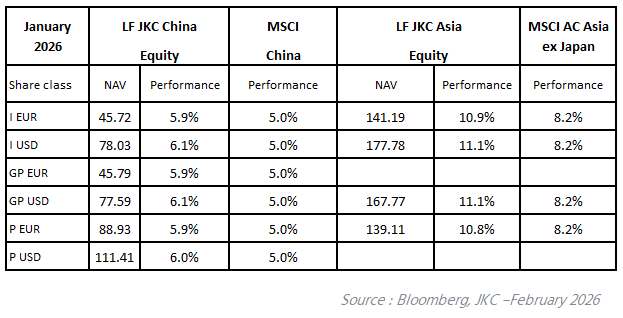
La Francaise JKC China Equity saw its NAV per share increase by 5.9% in January when the MSCI China index increased by 5.0%.
The cash position of the fund stood at 5.7% at the end of the month.
The best performers in the fund this month were Zijin Gold International (+49.2%), China Life (+27.0%), Kuaishou Technology (+24.9%), Suzhou TFC (+23.0%) and Alibaba (+18.1%). The worst performers were Trip.com (-13.3%), Sungrow Power (-11.2%), PDD (-10.9%), Xiaomi (-10.0%) and Zhejiang Sanhua (-8.4%).
In January we reduced our exposure to Xiaomi and Tencent Music while we increased our exposure to Suzhou TFC. There was no addition to the portfolio.
ASIA PORTFOLIO
La Francaise JKC Asia Equity saw its NAV per share increase by 11.1% in January when the MSCI Asia ex-Japan index increased by 8.2%.
The cash position of the fund stood at 4.7% at the end of the month.
The best performers of the fund this month were Zijin Gold International (+49.2%), Park Systems (+45.1%), SK Hynix (+39.5%), Samsung Electronics (+33.9%) and Chroma ATE (+26.3%). The worst performers were Trip.com (-13.3%), Rainbow Children’s Medicare (-12.7%), Sungrow Power Supply (-11.2%), Polycab (-10.0%) and Mahindra and Mahindra (-9.6%).
In January we increased our exposure to Samsung Electronics, Suzhou TFC, Ping An Insurance and Trip.com while we reduced exposure to Tencent Music and DBS. We added Kaori Heat Treatment while we exited Rainbow Children’s Medicare, Xiaomi and ICBC.
ESG HIGHLIGHTS OF THE MONTH
January 2026 underscored the continued bifurcation of the ESG landscape: major Asian financial centers took concrete steps to institutionalise climate disclosure and broaden the scope of “sustainable” capital allocation to include real-economy transition and adaptation, while Western policy signals remained uneven.
In China, regulators released a corporate climate reporting standard – Corporate Sustainable Disclosure Standard No. 1 – Climate (Trial) – marking a significant move to codify how companies identify, measure, and disclose climate-related information. The standard is aligned with the IFRS Foundation’s climate framework and is intended to enable reporting on climate-related risks, opportunities, and impacts in support of China’s green development objectives. Structurally, it mirrors the IFRS S2 architecture, anchoring disclosure around the core pillars of Governance, Strategy, Risk and Opportunity Management, and Metrics and Targets.
Hong Kong advanced in parallel, announcing the Hong Kong Taxonomy for Sustainable Finance Phase 2A, which expands its classification system for environmentally sustainable economic activities to include transition activities and climate adaptation, while also covering a significantly broader set of sectors and activities. By explicitly recognizing transition and adaptation, Hong Kong is widening the channels through which capital can be directed toward decarbonisation and physical-risk preparedness—while simultaneously raising expectations for evidentiary rigor and defensible classification.
Europe, meanwhile, reinforced that ESG is no longer solely a disclosure issue but increasingly a matter of prudential supervision. The European Central Bank (ECB) said it will intensify monitoring of how banks manage physical climate risk and how credible their transition plans are in practice. This stance is consequential because it ties climate considerations to core supervisory priorities—governance, risk appetite, scenario analysis, and capital planning—rather than treating them as peripheral or purely reputational concerns.
Against this backdrop of standard-setting and supervisory tightening, the United States’ formal withdrawal from the Paris Agreement delivered a sharp countersignal at the federal level. While the near-term practical implications for corporate obligations will depend on responses from various government agencies, the move reinforces political volatility around climate policy and complicates international alignment for firms operating across jurisdictions.
The information contained herein is issued by JK Capital Management Limited. To the best of its knowledge and belief, JK Capital Management Limited considers the information contained herein is accurate as at the date of publication. However, no warranty is given on the accuracy, adequacy or completeness of the information. Neither JK Capital Management Limited, nor its affiliates, directors and employees assumes any liabilities (including any third party liability) in respect of any errors or omissions on this report. Under no circumstances should this information or any part of it be copied, reproduced or redistributed.